We awoke this morning to beautiful skies and perfect temperatures to get out and explore as we made our way to Cornwall. After packing our bags and loading up the car, we headed towards Saltram, which is a National Trust Estate just north of Plymouth.
I'm not sure if I've mentioned it, but the National Trust is sponsoring its annual National Day Out, where they offer free admission to anyone interesting in visiting a property. This actually doesn't benefit us, as we already belong to their partner site, but it certainly does account for the vast amount of cars in the parking lot when we arrived just 5 minutes after the opening of the gate.
In 1614, Sir John Bagge purchased the house and woods on this property from the Mayhowe family, which framed the beginning of the known history of this magnificent estate. The name of Saltram stems from the "salt" that was mined in the nearby estuary.
The house began in the Tudor style, but was remodeled in the Georgian style in the 1740's when the house came under the ownership of the Parker family.
The doors did not open until 11:00, so we decided to take the opportunity to walk around the estate to admire the beauty of the grounds.
Around the corner there were statues tucked into alcoves on the side of the house.
And a side door is flanked by two Sphynxs which I found to be quite unusual.
I could find no explanation for the statuary, so I can only presume that the owners thought they would enhance the outside of the house. They are on the side opposite a walled garden.
Which was quite stunning in itself.
I was suprised to view so many tropical trees on the grounds, including a couple banana trees.
Along one of the paths, we came across a small temple that had an overlook. The view is limited in present day, but a tidal river stands in the distance down in the valley, and it can only be presumed that this temple was designed to sit and enjoy the vista.
I was peering into the distance, attempting to locate the river, when I spotted a large bright green bird flying by. I mentioned it to Marty, but he seemed confused by what I was trying to explain. (In truth, I don't think he believed me. ) Then, a second bird of the same color flew by, and that piqued Marty's interest enough to turn on his phone app that recognizes bird calls. And, lo and behold, it showed the rose ringed parakeet.
We never did spot them again, but I did have a fellow visitor tell me that these were escaped parakeet's and that the Magpie's detest them. Just in case you are curious, these aren't the size of parakeet's that we are familiar with. They are about the same size as a large pigeon. Definitely not easy to miss when they are flying. Marty and I were pretty excited about that discovery. After all, when do you see chartreuse birds flying in the wild?
Walking along, we continued to be enthralled with the beauty of the gardens.
On the far end of the lawn, there stood a castle folly.
The door was locked, but I could peer inside through the window.
I thought it looked like an enchanting place to get away for a little while. From here, we made our way back to the house along the path that was lined with Lime Trees.
Walking through the front door, we were greeted by an enthusiastic National Trust volunteer who was eager to explain some of the history. She mentioned that the entrance way had been designed to impress visitors, and it's not too difficult to imagine that.
I was certainly impressed!
The famous architect, Robert Adam, was commissioned to design the interior in several of the rooms that we toured today. It's easy to spot his style after visiting so many of the houses that he and his brothers had been hired to enhance. I liken it to a "Wedgewood" look. Such detail that is carefully placed resulting in a 3D display of beauty. This is part of the ceiling in the drawing room.
The room is huge. The carpet itself is 44 feet long by 24 feet wide.
The dining room was once a library, but was converted and also detailed by Robert Adam.
As is typical of so many of these type of houses, there were myriads of paintings hanging on the walls.
The center photo was of the Reynolds children.
And this is Theresa Parker and her son John Reynolds.
Marty took a photo of this painting that was rather out of place among the others. It turns out that it is a Reuben and had been purchased for the family collection. At least those eyes didn't follow the viewer like some others that we've seen.
There was a room that was decorated with Chinese style wallpaper.
And, along the one wall, there was a large cabinet filled with unusual porcelain pieces.
Could this be a connection to the Rose Ringed Parakeet?
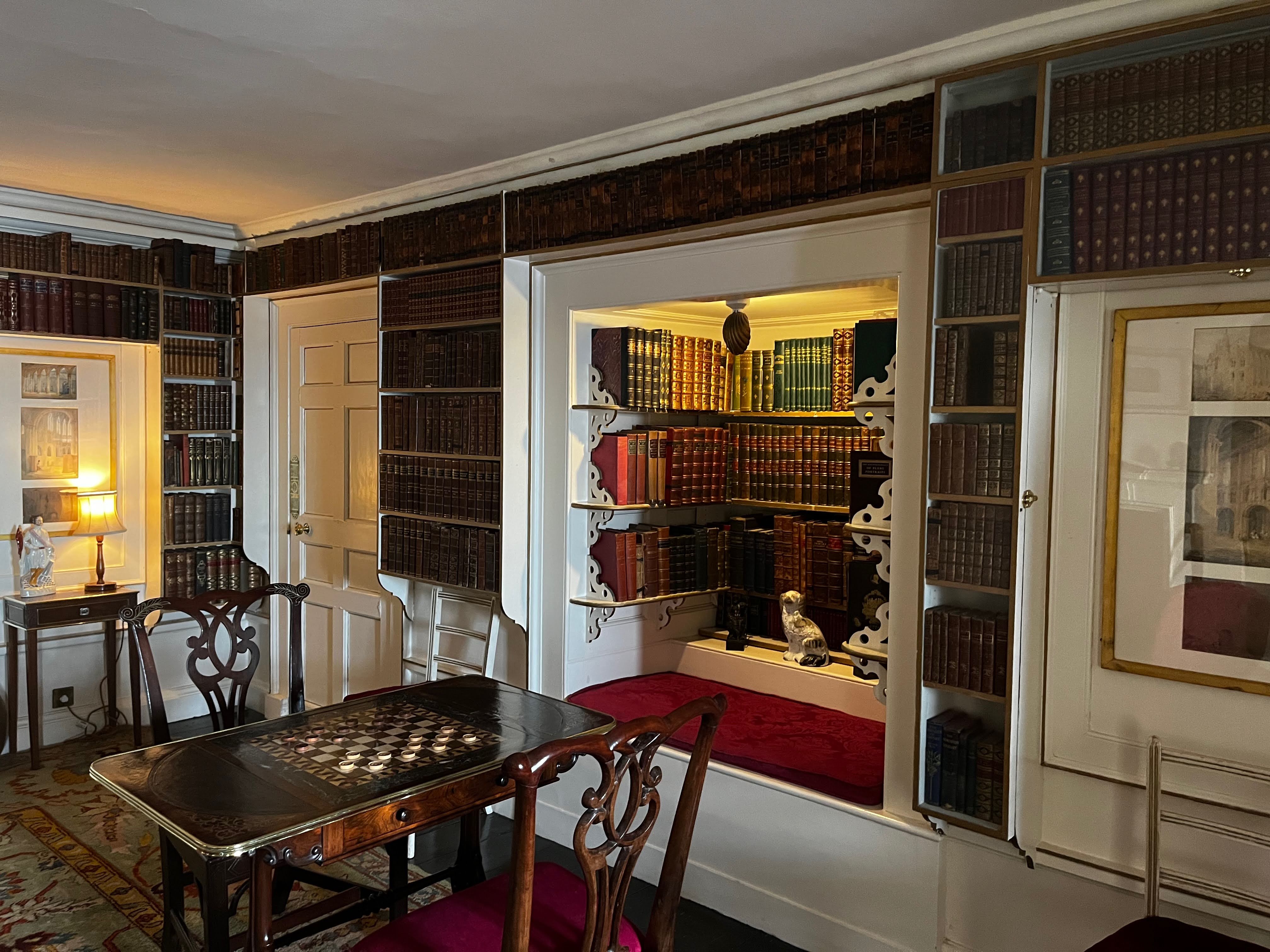
The library contained a vast amount of books, in addition to musical instruments on the one end
and paintings hung around the perimeter above the book cases.
The oldest book in the house, the tall grey one on the second shelf in the middle of the photo, dates back to 1460. How amazing is that?
When we entered the house, we were told that we could only visit the downstairs rooms because there were not sufficient guides to cover all of the upstairs rooms as well. Although that sounded like a reasonable explanation, I have the strong suspicion that the tour was so limited because the admission was free. What better way to entice someone to return than to tempt them with such amazing features, that they would want to come back in the future to see the upstairs as well.
We weren't disappointed, as we felt that our tour covered a lot of ground. The volunteers are SO excited to tell you about these families, as if they were one of the family members themselves. Their exuberance is to be commended. It's what makes visiting these places so entertaining!
But it was time to head out, so we made our way to the car park to begin our drive to Cornwall.
But wait! Are there any Jane Austen fans out there? You might be interested in knowing that Saltram was featured in filming of Sense & Sensibility starring Kate Winslet and Emma Thompson. It was just a short scene, but this was the home that the family had to leave after the death of their father. Just an interesting tidbit to share.
It took us a few hours to make the trip from Saltram to our destination, but the drive did not involve hedgerows (thank goodness!) and the views along the highway were outstanding.
We are staying in Penzance at a B&B on the edge of the town. Our room is actually that upstairs extension with the windows and it looks out over the street. It's really quite lovely.
We decided to head to mass which was about a half an hour's walk away. The church had a beautiful stained glass window with an unusual crucifix hanging in front.
Afterwards, we walked to the Singing Rooster, which was a small Polish restaurant that I had spotted while arranging the trip. Luckily, I made reservations as the young man in charge had to turn away numerous walk ins as the tables had all been booked for the evening. That being said, there were only six tables. But, there was only one chef, who was obviously the owner, and one member of staff to wait the tables.
We didn't see any singing roosters, but we certainly did view quite a variety! Someone's surely had some fun with the theme!
Dinner was not only delicious but also entertaining as both the chef and the waiter took the time to chat with us and share some humorous stories.
We headed back to our hotel, and I felt compelled to take a photo of this giant palm tree. I was pretty surprised to find these trees growing here as I had associated them with a warmer climate. But it appears that I was wrong on that mark.
That's it for today. We have an early morning adventure, so it's time to hit the sack.
Until next time...








.jpeg)


