Today was another "dodging hedgerows" adventure, where the roads assigned to our navigation are barely wider than the car, and edged with 8 ft high prickly bushes on either side. Certainly not for the feint of heart, that's for sure.
But, Marty handled the driving well, and we only had two instances where he needed to reverse the car nearly as far as he'd gone on a particular road, because the car driving the opposite direction gave no indication of yielding anywhere along the way.
Nail biting certainly would have been appropriate, but we actually found ourselves laughing at the absurdity of the situation. And, we're fairly certain that locals must have some secret directions to these places, because we are always surprised by the full parking lots when we arrived. Just where did these people come from in these extremely remote places?
Our day began with us awakening to yet another morning of brilliant sunshine. Then, a tasty breakfast
before heading out to our intended destination, Buckland Abbey which was on the opposite side of the Dartmoor Forest. We decided this was the perfect opportunity to drive through the forest, even though we knew it would be a bit more challenging than taking the highway. We are on holiday, so why not enjoy the vistas we'd miss otherwise?
As I mentioned, we did have more than our share of hedgerow adventures, but once in the moors, the scenery changed dramatically. And instead of dodging greenery, we found ourselves on the lookout for free to roam creatures.
This fella came right up to Marty's window when he stopped to let the rest of the group pass along.
As you can see, the scenery was magnificent.
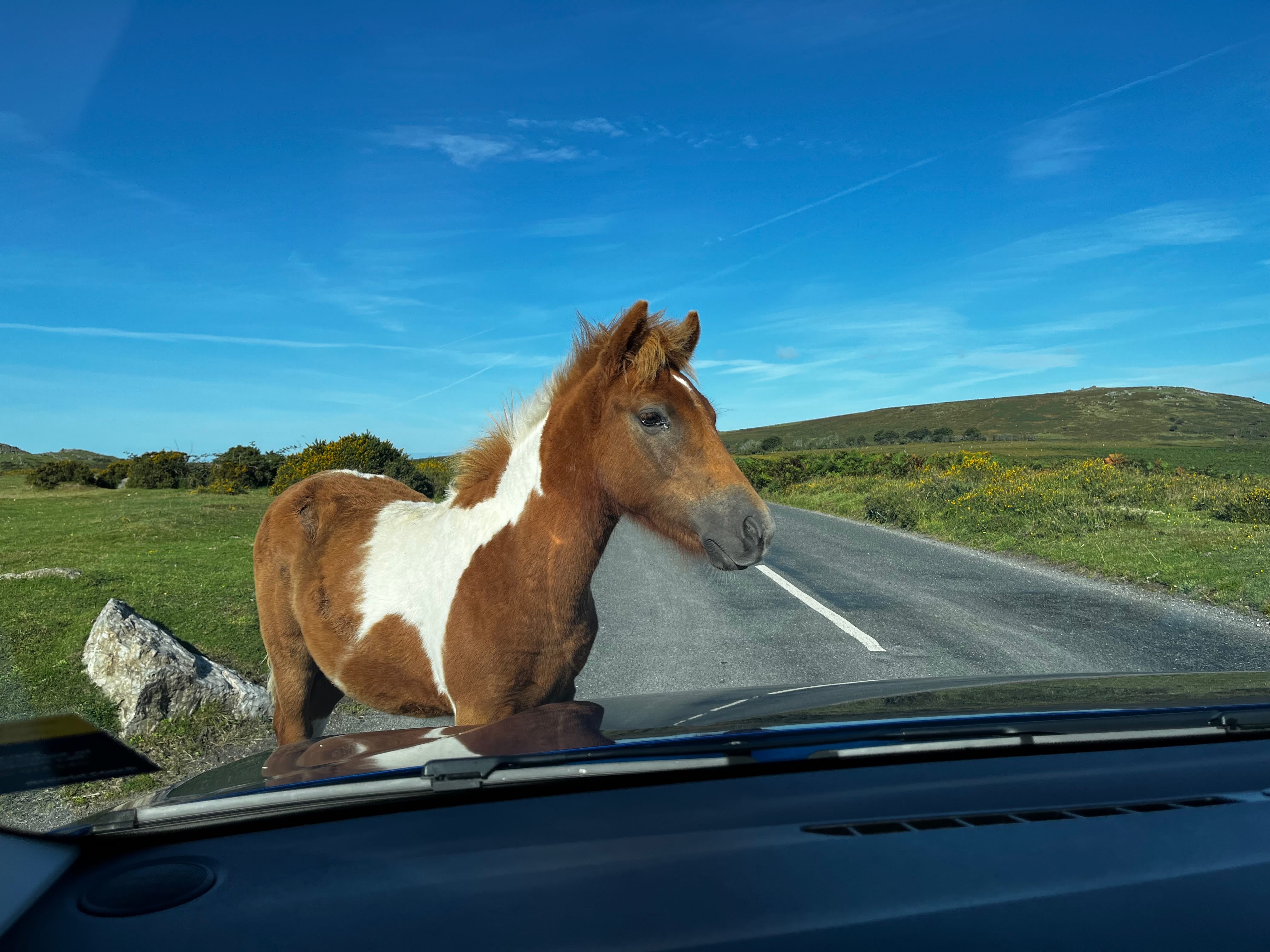
A little further up the road we spotted wild horses
where this fella stood and refused to budge for quite some time, before one of the stallions convinced him to move along.
Just down the road these cheeky sheep acted like they owned the road. And, well, perhaps they do.
We were thrilled to be welcomed by this bovine beauty. Talk about being in the right place at the right time!
Just on the other side of the moors stands a residence called Buckland Abbey.
As the name implies, it was actually a Cistercian Monastery founded in 1278.
But similar to Mottisfont, where we toured on Wednesday, the abbey was subject to the dissolution of the monasteries by King Henry VIII. The king seized the property and eventually leased it to Richard Grenville in 1541.
His grandson was responsible for converting the abbey into a fashionable home.
In 1581, the abbey with its property was sold to Sir Francis Drake, newly knighted by Queen Elizabeth in gratitude for his defeat of the Spanish Armada. The property stayed in Drake's family until 1946 when it was sold to a local retired soldier who was primarily interested in the land. He then gifted the property to the National Trust in 1946.
During the transition period, an artist known as Roland Pym, was commissioned to paint four murals that featured the adventures of Sir Francis Drake. In the ground floor of the building, these murals are featured along the walls.
Many of the rooms held artifacts that belonged to Sir Francis Drake and his family. There was a portrait of his one wife, Elizabeth Sydenham, among the collection.
and there were replicas of items as well.
In the corner of the dining room, a glimpse of a Biblical figurine from the Abbey is featured in the corner.
One of the rooms features a fireplace with the coat of arms granted to Sir Francis Drake from Queen Elizabeth.
In the main part of the lower floor there stands a great hall that still has the original tile from the days that the monks lived in the abbey. How amazing that it has held up all of these years considering that we were welcome to walk on it ourselves.
Exiting the house, you can see the beauty of the magnificent surroundings.
Of course, a brilliant blue sky certainly does enhance the beauty.
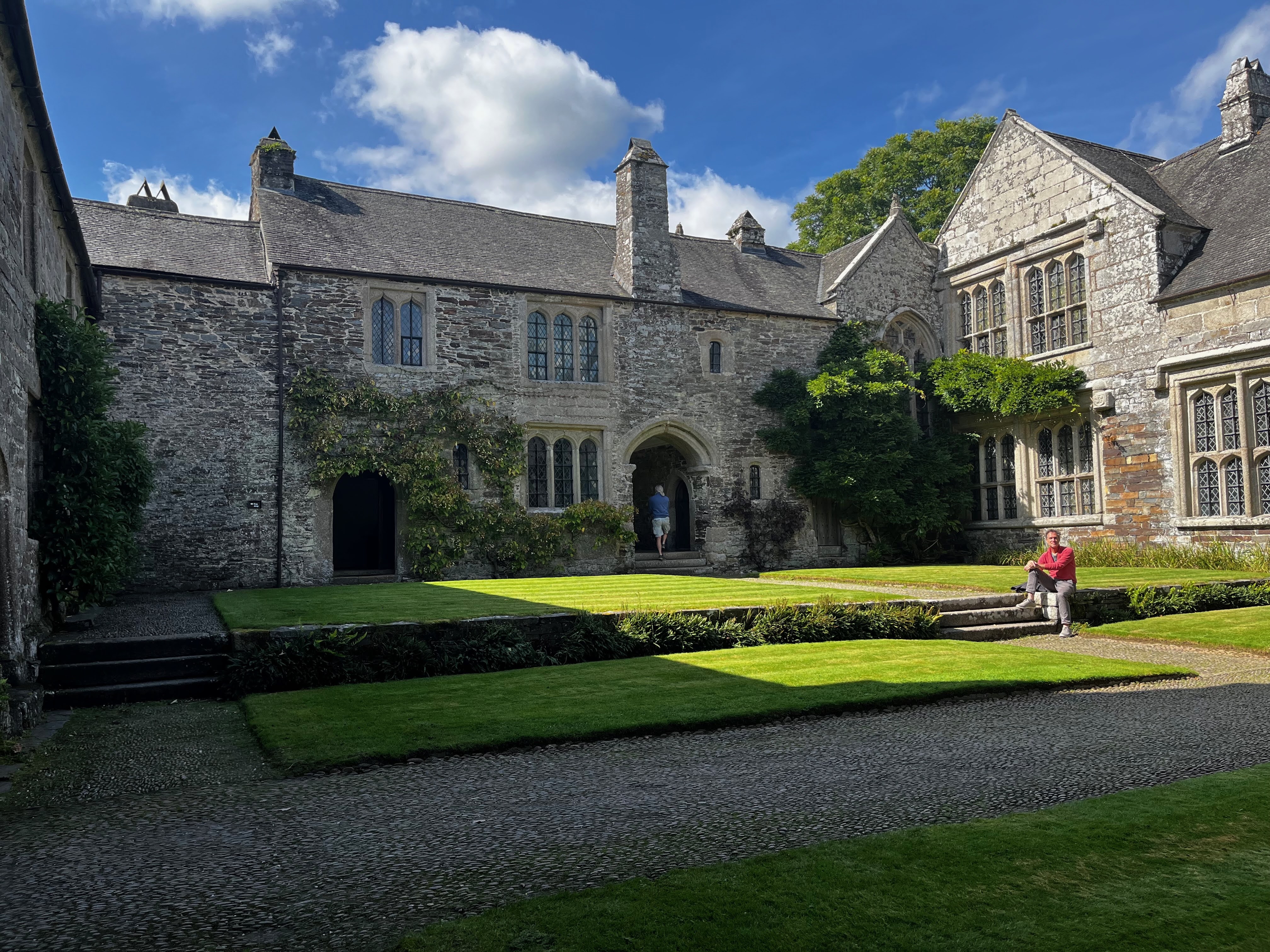
Moving on, we made our way to Cotehele, a family home to the Edgecumbe family. It has existed since Tudor times, staying in the family until it was gifted to the National Trust.
Richard Edgcumbe earned a knighthood from King Henry VII due to his valor during the Battle of Bosworth. By the 18th century, the family had built a new home in Plymouth and this gem was used primarily as a second home. It was noted that tin 1789, King George III and his wife, Queen Charlotte, visited for breakfast one morning.
In 1941, the home suddenly became the primary living residence when the house in Plymouth was bombed during the blitz. After the war, the family decided to rebuild the bombed house in Plymouth and at that point, gifted Cotehele to the National Trust as they could not afford to keep both.
Walking to the entrance, I couldn't help but chuckle at the large apple mosaic featured in the front lawn.
The giant apple is made up of real apples, all taken from trees that are located in an orchard on the grounds. How clever is that?
And it smelled quite delicious entering the courtyard.
Each of the rooms had a detailed framed drawing that was used to base the recreation of what the house looked like in the late 19th century. The main hall at the entrance maintains its original Tudor look and decor.
One of the unique features of this property is the vast number of tapestries that hang on the walls. Every room that we entered had huge, heavy, silk tapestries lining the stone walls. They were not "made to order" as you see in some of these Georgian homes. Rather, these were purchased by the family from private collectors, then cut and bound to fit the required spaces. It really was quite remarkable to see.
The original chapel in the house, built in 1411, still exists, and is presently a consecrated Anglican church. But the original items from the days of Catholicism still exist in windows as various items like a large framed altar cloth and painted wooden Triptych.
All of the bedrooms featured very large fireplaces with extremely ornate bedding as well as the tapestry lined walls designed to enhance warmth.
This property is certainly unique in the fact that it continues to have many of the collectibles that were accumulated by owners over the years. The Trust has done an excellent job in preserving them.
The house is located up hill from the River Tamar where an old mill still stands but is not functioning. We walked down for a quick peek, and a refreshing cream tea before making our way north for a stop in at Lydford Gorge.
We arrived just half an hour prior to closing, but we were told that we were welcome to enter, and just exit on our own at the completion of our walk. So, I grabbed my walking sticks and we began the journey to Devil's Cauldron, located at the bottom of the Lydford Gorge.
We crossed a bridge that stands over the stream
and made our way along the narrow, rocky path. I spotted this marker that looks like a telephone, and wondered what that might be. Marty was able to confirm that the number is a location marker. So, if one runs into some sort of physical problem, and needs to call for help, one gives them the number on the marker.
How clever is that?
At some points, the water was eerily still as you can see from the photo.
Making our way down was a bit tricky.
And we came to the spot where one could enter through a gate to stand on that viewing platform. Although the photo doesn't look that fearful, those rocks are have no barrier, and the surfaces were very slippery from the rain. There was no way that I was going to attempt climbing down them, and, luckily, Marty was happy to refrain as well. Whew! That was a relief. Just below that platform is an enormous rush of water. It is referred to here as a giant pothole, which is far different than what we describe as a pothole.
We could glimpse the rushing water in sections as we climbed back up and out of the gorge.
Having successfully completed that venture, we drove up the road to a second site for Lydford, but this time with the intention of seeing the White Lady Waterfall.
We began the walk from the parking lot
and soon spotted the entrance below the old railroad bridge.
This path was relatively long in comparison to the gorge walk, and it involved a long stretch of decent, which I found to be quite challenging. I had just wondered if I would be able to continue on, when I spotted the bridge in the distance. I had presumed that we needed to cross over.
Much to my delight, I turned the corner to look, and lo and behold, there was the waterfall!
Pictures don't do it justice. It was literally right above my head tumbling with a large crash into the water below. Well worth the hike down, and back up as well!
The hike back up the hill actually took much less time than the decent, and we were soon making the hour drive back to our hotel.
Dinner was in a fabulous pizzeria named San Benedetto and also owned by the Benedictine Monastery. It was an easy walk from the hotel, and as you can see, quite lovely with the turning waterwheel on the outside of the adjacent building.
And, in the opposite direction, Buckfastleigh Abbey in the distance.
Dinner was like revisiting our recent trip to Tuscany in May: The wine was excellent, the pizza perfect, and gelato delectable!
But, by far, the best part of the dinner was our entertaining waiter, born and raised in Italy but living now in Buckfastleigh. He loved to talk, and we enjoyed listening.
And, he even agreed to take our photo for our memories.
The perfect evening to a lovely day!


.jpeg)